Tel: +971 4 396 7982
Mobile: +971 55 989 3299
Email: info@guptaaccountants.com

Corporate Tax Return Filing in Ajman
Corporate Tax Return Filing in Ajman
Gupta Group International
2/26/20267 min read


Corporate Tax Return Filing in Ajman
Corporate Tax Return Filing in Ajman: A Complete Guide for Businesses in the UAE
From startups to multinational corporations, every business operating in Ajman — whether on the mainland or within a free zone — must navigate the UAE’s federal corporate tax system. With the introduction of the corporate tax regime in the United Arab Emirates, companies now face new compliance obligations, including annual corporate tax return filing. This blog is your authoritative guide to understanding what corporate tax return filing means in Ajman, why it matters, who must file, how to file, and how your business can stay compliant.
Whether you are a seasoned finance professional, a business owner establishing your first entity in Ajman, or a decision-maker seeking clarity on tax requirements, this article is designed to walk you through every aspect of corporate tax return filing in Ajman — clearly, comprehensively, and strategically.
Understanding Corporate Tax in the UAE: An Ajman Perspective
The United Arab Emirates introduced its federal corporate tax regime to align with international best practices and promote economic competitiveness. While the country has historically operated as a tax-neutral jurisdiction, this new tax system applies to all businesses with taxable profits in the UAE — including those based in Ajman.
🔹 What Is Corporate Tax?
Corporate tax is a tax imposed on the taxable profits of companies. In the UAE:
The standard corporate tax rate is 9% on taxable net profits exceeding AED 375,000.
Qualifying entities in designated zones or sectors may benefit from a 0% tax rate under specific conditions.
This system applies across all seven emirates — including Ajman — and impacts mainland companies, free zone entities, and branches of foreign corporations alike.
🔹 Why Now?
The introduction of corporate tax modernizes the UAE’s fiscal framework, bringing it in line with global standards for transparency, economic substance, and regulatory compliance. It also enhances investor confidence and aligns with international regulatory expectations.
Why Corporate Tax Return Filing Matters in Ajman
Filing an annual corporate tax return is more than a legal requirement — it plays a strategic role in your organization’s financial health, credibility, and long-term success.
Here’s why getting your tax return right matters:
1. Regulatory Compliance
All qualifying businesses must file their corporate tax returns by the set deadlines. Non-compliance can result in financial penalties, interest charges, and even reputational risk.
2. Financial Transparency
Accurate tax returns reflect robust financial reporting. Investors, lenders, and stakeholders rely on these filings to assess your company’s performance and credibility.
3. Audit Readiness
A tax return backed by organized financial records ensures smoother audit engagements and minimizes compliance risks with the Federal Tax Authority.
4. Optimized Tax Planning
Timely returns allow your business to accurately compute its tax liability, identify deductions, and plan for future financial years.
Who Must File a Corporate Tax Return in Ajman?
Company structure, activities, and tax residency determine who is required to file a corporate tax return in Ajman. In general:
1) Ajman Mainland Companies
This includes Limited Liability Companies (LLCs), professional firms, service providers, and commercial entities licensed by Ajman’s Department of Economic Development.
2) Free Zone Entities
Companies registered in Ajman Free Zones — such as Ajman Free Zone — may enjoy preferential tax treatment, including potential 0% corporate tax. However, this is conditional upon meeting specific compliance requirements such as economic substance, transfer pricing documentation, and regulatory conditions.
3) Branch Offices of Foreign Companies
Foreign entities with branches operating in Ajman must file corporate tax returns for their UAE-sourced profits.
4) Joint Ventures and Partnerships
Entities structured as partnerships or joint ventures with taxable activity must also file returns.
5) Professional and Consulting Firms
Regardless of size, if your firm generates taxable profits, it must file.
Even if your company has zero taxable income during the year, a “nil” corporate tax return may still need to be filed to demonstrate compliance.
Ajman Corporate Tax Filing Deadlines: What You Need to Know
Timeliness is critical. The Federal Tax Authority (FTA) of the UAE has established strict filing deadlines based on your financial year.
1) Tax Year Structure
The default tax period runs from January 1 to December 31.
Companies can request to adopt a different financial year with FTA approval.
2) Filing Deadline
A corporate tax return must be filed within nine months after the end of the financial period.
Example:
If your financial year ends on December 31, 2024, your tax return must be submitted by September 30, 2025.
3) Tax Payment Deadline
Any tax liability must be paid by the filing deadline. Late payment may attract fines and penalties.
Failing to meet these deadlines can lead to:
Late filing fines
Interest on unpaid tax
Compliance sanctions
Step-by-Step Guide to Corporate Tax Return Filing in Ajman
Now that you understand who must file and when, here’s a systematic breakdown of how to file your corporate tax return:
Step 1: Register with the Federal Tax Authority
You must be registered with the FTA’s corporate tax portal. Registration is the gateway to filing electronically and receiving compliance notifications.
Step 2: Prepare Financial Statements
Your company must maintain accurate financial records, including:
Audited financial statements (if applicable)
Trial balance
General ledger
Income and expense records
In Ajman, audited financial statements are often a foundational document for filing.
Step 3: Calculate Taxable Profit
Taxable profit is computed as:
Net accounting profit + non-deductible expenses – allowable deductions – exemptions
This figure determines the tax liability at the applicable rate.
Step 4: Gather Supporting Documentation
When preparing your filing, ensure you have:
Financial statements
Bank statements
Invoices and receipts
Transfer pricing documentation (for related party transactions)
Free zone compliance certificates (if applicable)
Step 5: File Electronically via the FTA Portal
Corporate tax returns must be submitted electronically through the FTA’s secure portal. Ensure:
Correct formats (JSON or XML where required)
All supporting documents are attached
Information is accurate and reconciled
Step 6: Review and Submit Tax Payment
After submission:
Check for confirmation or validation messages from the portal.
Pay any outstanding corporate tax liability by the deadline.
Retain records of submission and payment receipts.
Required Documents for Corporate Tax Return Filing in Ajman
Here’s a comprehensive list of documents typically required for corporate tax return filing:
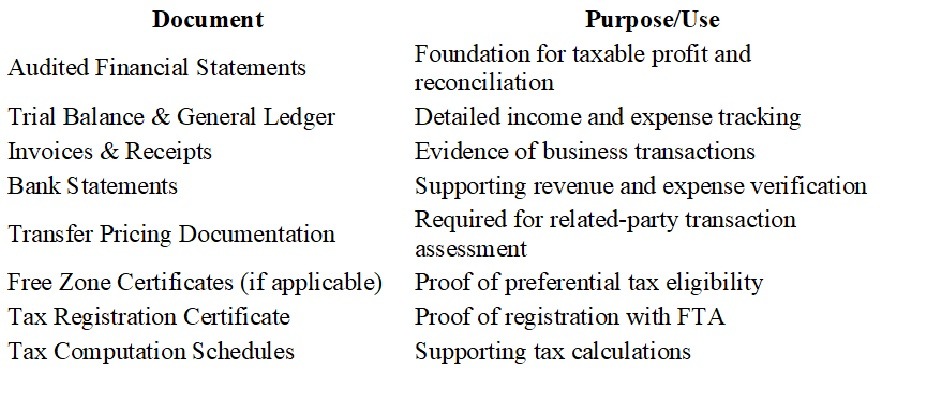
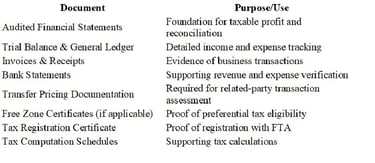
Maintaining complete documentation helps ensure accuracy and minimizes audit risk.
Corporate Tax in Free Zones: Ajman Free Zone Insights
Ajman Free Zone has become a key hub for international business due to its strategic location and competitive incentives. Under the UAE’s corporate tax regime:
1) 0% Tax Eligibility
Many free zone companies may qualify for a 0% corporate tax rate if they:
Perform genuine economic activities
Maintain sufficient staff and operational substance
Comply with economic substance requirements
Fulfill transfer pricing documentation requirements
2) Key Compliance Conditions
To retain 0% status:
Maintain adequate physical presence and workforce
Conduct operational activity within the UAE
Ensure appropriate documentation and reporting
3) Risk of Loss of Benefits
Failure to meet regulatory requirements may trigger tax liabilities at the standard rate of 9%.
Professional compliance review and expert guidance are often necessary to ensure your free zone company maximizes its tax benefits.
Transfer Pricing Rules and Ajman Corporate Tax Filing
Transfer pricing refers to pricing transactions between related parties, such as:
Parent companies and subsidiaries
Companies under common control
Related legal entities
Under UAE corporate tax law, related-party transactions must be conducted at arm’s length — meaning they reflect the price that unrelated parties would have agreed upon in the open market.
1. Why Transfer Pricing Matters
Ensures that taxable profits are accurately reported
Prevents artificial tax base erosion
Improves transparency in intercompany transactions
2. Documentation Requirements
Companies must maintain a transfer pricing policy, supporting analysis, and comparative data — ready for submission or audit.
Common Pitfalls in Ajman Corporate Tax Return Filing
Even experienced businesses can make mistakes. Avoid these common compliance errors:
1. Late Filing
Missing deadlines can result in fines and penalties.
2. Inaccurate Financial Reporting
Unreconciled accounts, missing entries, or incorrect classifications can trigger audits and disputes.
3. Missing Documentation
A lack of proper invoices, receipts, or supporting schedules slows down compliance review.
4. Incorrect Tax Computation
Errors in computing taxable profit can result in penalties and reassessments.
5. Ignoring Transfer Pricing Requirements
Related party transactions without documentation may raise compliance concerns.
Penalties and Enforcement in Ajman
The Federal Tax Authority has established penalties to enforce compliance. These may include:
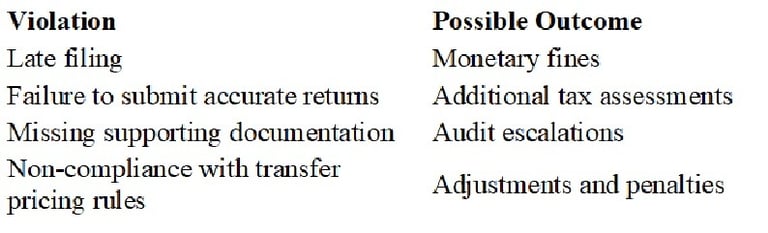
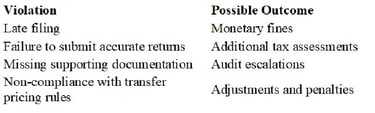
By filing accurately and on time, businesses in Ajman safeguard themselves from avoidable fines, disputes, and compliance issues.
The Role of Professional Support in Corporate Tax Filing
Managing corporate tax compliance in Ajman requires technical knowledge, precision, and strategic planning. For many businesses, professional support becomes an essential asset.
Why Professional Assistance Helps
Comprehensive interpretation of tax law
Accurate preparation of returns
Compliance with transfer pricing and substance requirements
Audit support and risk mitigation
Liaison with Federal Tax Authority
At uae-corporatetaxfiling.com, expert consultants guide businesses throughout the corporate tax filing lifecycle — from initial registration to final submission and beyond.
Case Study: Ajman Company That Streamlined Tax Filing
Company Beta, a technology and consulting firm registered in Ajman:
Operated across multiple service lines
Had incomplete financial records
Faced a tight tax filing deadline
After engaging professional support:
Financial records were reconciled
Required documentation was completed
Corporate tax return was filed accurately and on time
Tax liability was optimized legally
Outcome: Company Beta avoided penalties, refined its financial reporting systems, and strengthened investor confidence.
Corporate Tax Return Filing in Ajman
The introduction of corporate tax in the UAE represents a major evolution in the country’s fiscal landscape — including for businesses in Ajman. Filing your annual corporate tax return accurately and on time is now a cornerstone of corporate compliance and financial integrity. From maintaining clear financial records to understanding transfer pricing, navigating deadlines, and securing eligible benefits for free zone entities, corporate tax return filing demands attention, expertise, and proper planning.
Whether you are a new startup, an expanding enterprise, a free zone investor, or a multinational branch office, mastering corporate tax compliance in Ajman will strengthen your business’s legal standing, financial transparency, and growth prospects.
If your company needs expert guidance on corporate tax return filing — including computation, document preparation, submission, or compliance review — the team at uae-corporatetaxfiling.com is here to support you with trusted, professional services.
© 2026 www.uae-corporatetaxfiling.com